
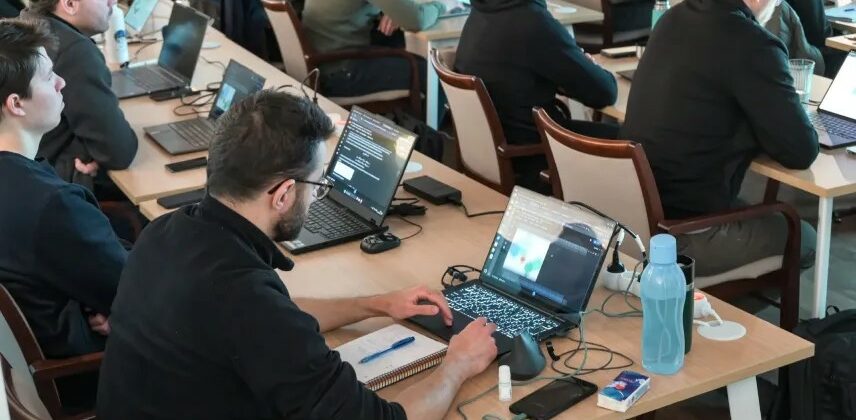
Two DH-LAB researchers, Gábor Palkó and Zsófia Fellegi, will take part in the advanced courses of the HUN-REN Frontiers of AI training programme, organized by HUN-REN and held in February and March. Our colleagues also attended the programme’s first, Deep Learning–focused module, which took place at the HUN-REN headquarters between 19–23 January 2026.
The intensive training, comprising a total of 5×8 hours, provided a comprehensive introduction to the theory, main architectures, and practical applications of neural networks. The programme aimed to ensure that participants understand the core principles behind deep learning models, can apply them to a range of problems, and gain insight into how these technologies underpin large language models and other intelligent AI systems.
The course was designed to closely integrate theory and practice: thematic units were complemented by hands-on Jupyter Notebook exercises using TensorFlow and Keras. Participants reviewed the fundamentals of neural networks, optimisation and regularisation techniques, major architectures (CNNs, RNNs, transformers), as well as modern approaches to representation learning and fine-tuning. Practical tasks included building image recognition networks, neural text classification, and implementing simple language models.
The course was taught by Levente Szabados, an AI and deep learning specialist with more than 15 years of research and industry experience. He is currently an instructor at the Frankfurt School of Finance & Management and an expert and advisor in international AI development projects. Thanks to his practice-oriented teaching approach, participants gained immediately applicable knowledge relevant to both research and development contexts.
The completed module constituted the first element of HUN-REN’s AI training programme, which will be followed by additional advanced courses, including the Agentic AI and Deep Modeling specialisations.
For DH-LAB, keeping pace with the latest AI methods and tools—and integrating them into research practice—is a strategic priority. Our colleagues’ participation in the programme contributes to ensuring that the lab supports digital humanities and data science projects with up-to-date expertise.