

We are pleased to report that studies by three Hungarian authors have been published in the latest thematic issue of Dacoromania Litteraria, a Q1-ranked international scholarly journal. These publications simultaneously signal the international visibility of Hungarian literary studies and the strong presence of digital and theoretical approaches in contemporary research.
Two of the authors, Gábor Palkó and Zoltán Kulcsár-Szabó, are lecturers and researchers at the Faculty of Humanities of Eötvös Loránd University. Gábor Palkó is also the head of the National Laboratory for Digital Heritage, and the publication of his study therefore also demonstrates the international embeddedness of Hungarian digital humanities. The third author, Ágnes Hansági, is a member of the Faculty of Humanities and Social Sciences at the University of Szeged, contributing to the issue as a whole through her interpretation of 19th-century Hungarian prose in an international context.
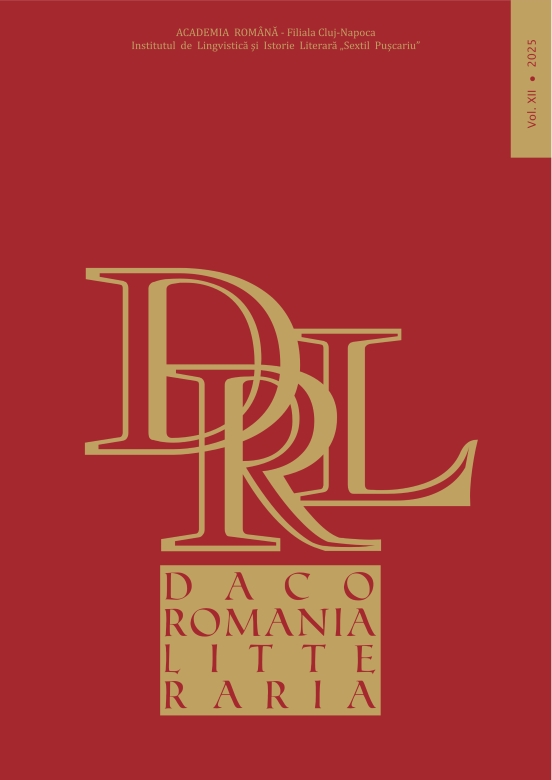
About the journal
Dacoromania Litteraria is an open-access, peer-reviewed, annual scholarly journal published by the Sextil Pușcariu Institute of Linguistics and Literary History, which operates as a branch institute of the Romanian Academy in Cluj-Napoca. As a multilingual platform, the journal examines Romanian literature and the broader literatures of Central and Eastern Europe in an international framework, placing particular emphasis on the transnational circulation of ideas, forms, and canons. Its history dates back to 1920, and its founder was Sextil Pușcariu. The journal thus represents both a significant tradition in the history of scholarship and a contemporary, comparative perspective.
The thematic issue
The 12th issue, published in 2025, is entitled Contemporary Spectres of the 19th Century in the Literature of Central and Eastern Europe and was edited by Tomasz Krupa and Mateusz Skucha. The thematic compilation seeks to answer the question of how the legacy of the “long nineteenth century” continues to live on in the twentieth- and twenty-first-century rewritings of Central and Eastern European literatures. The studies in the issue demonstrate, from a wide range of theoretical and methodological perspectives, that the nineteenth century is not a closed historical period but a cultural and literary point of reference that remains alive today, encouraging reinterpretation and debate.
Brief presentation of the three Hungarian studies
Gábor Palkó’s study revisits one of the fundamental hypotheses of computational literary studies through the analysis of a large-scale corpus of Hungarian novels. By examining the frequency of verbs referring to internal psychological states, he concludes that their aggregate proportion alone is not suitable for identifying major literary-historical period shifts; however, when subjected to a more fine-grained semantic breakdown, clearly interpretable patterns emerge that can be linked to specific periods. The study thus highlights both the limitations and the further potential of quantitative methods.
Ágnes Hansági’s paper analyses Mór Jókai’s prose from the 1880s in relation to metafiction, metalepsis, and the topos of the “burnt manuscript.” The study argues that certain texts by Jókai anticipate the self-reflexive procedures of modern and postmodern literature and can justifiably be read as nineteenth-century precursors to Jorge Luis Borges’s classic short story Pierre Menard, Author of the Quixote.
Zoltán Kulcsár-Szabó’s study examines the performative functioning of language in Sándor Petőfi’s poem National Song. The text analyses how poetic speech crosses into the sphere of political action and how the poem becomes an oath and, in a historical sense, an effective collective act. In addition to Petőfi, the analysis also incorporates works by Mihály Vörösmarty and János Arany, as well as a later reflection by Péter Esterházy, situating the discussion within a broader ethical and speech-act-theoretical context.
The full contents of the thematic issue are available at the following link: https://dacoromanialitteraria.inst-puscariu.ro/ro/nr12.php
The publication of the three studies constitutes important feedback on the international presence of Hungarian literary scholarship and clearly demonstrates the professional weight and multifaceted embeddedness of research associated with the National Laboratory for Digital Heritage and the Faculty of Humanities of Eötvös Loránd University.